
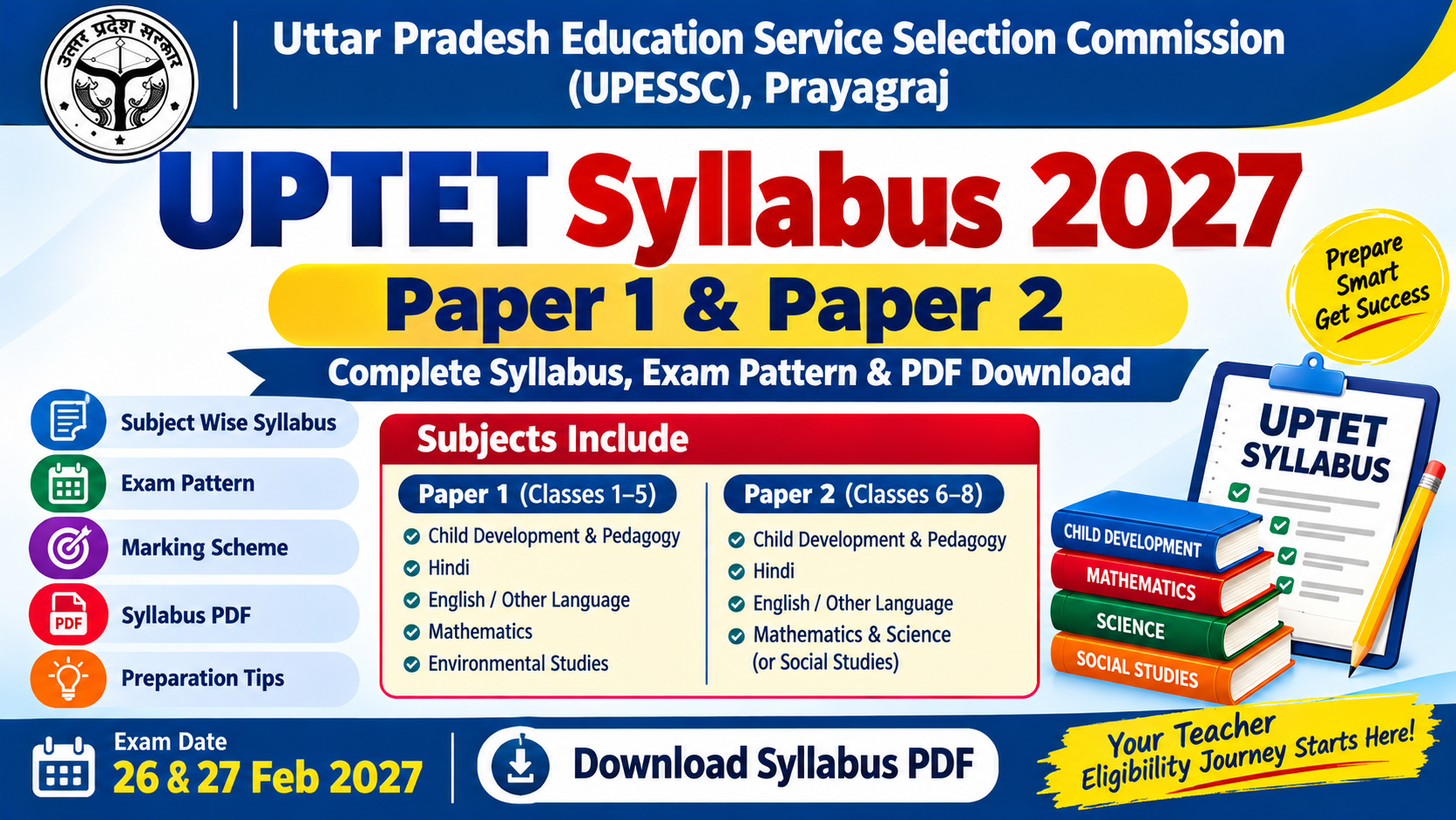
UPTET Syllabus 2027: Paper 1 & Paper 2 Subject Wise Syllabus, Exam Pattern and PDF Download
Organization: Uttar Pradesh Education Service Selection Commission (UPESSC), Prayagraj
Exam Name: Uttar Pradesh Teacher Eligibility Test (UPTET)
Exam Date: 26 and 27 February 2027
Official Website: upessc.up.gov.in
UPTET Syllabus 2027: The Uttar Pradesh Education Service Selection Commission (UPESSC) is responsible for conducting the Uttar Pradesh Teacher Eligibility Test (UPTET). Candidates preparing for the examination scheduled for 26 and 27 February 2027 should understand the complete syllabus and examination pattern before starting their preparation.
The UPTET 2027 syllabus covers important teaching subjects such as Child Development and Pedagogy, Hindi, English, Mathematics, Environmental Studies, Science and Social Studies. The syllabus is divided into two papers according to the teaching level.
UPTET Paper 1 is intended for candidates seeking teaching eligibility for Classes 1 to 5, while UPTET Paper 2 is designed for candidates interested in teaching Classes 6 to 8.
In this article, candidates can check the UPTET Paper 1 syllabus, UPTET Paper 2 syllabus, subject-wise topics, exam pattern, marking scheme, qualifying marks, preparation tips and official syllabus PDF links.
UPTET Syllabus 2027: Exam Overview
The Uttar Pradesh Teacher Eligibility Test is a state-level examination that assesses candidates' knowledge of school subjects, teaching methods, child development and classroom learning.
Candidates should understand the examination structure before preparing a subject-wise study plan.
| Particulars | Details |
|---|---|
| Conducting Organization | Uttar Pradesh Education Service Selection Commission (UPESSC) |
| Examination Name | Uttar Pradesh Teacher Eligibility Test |
| Popular Exam Name | UPTET 2027 |
| Examination Cycle | UPTET 2026–27 |
| Paper 1 | Primary Level (Classes 1–5) |
| Paper 2 | Upper Primary Level (Classes 6–8) |
| Type of Questions | Multiple Choice Questions (MCQs) |
| Total Questions | 150 per Paper |
| Total Marks | 150 per Paper |
| Exam Duration | 2 Hours 30 Minutes per Paper |
| Examination Mode | Offline (OMR-Based) |
| Negative Marking | No, under the previous pattern |
| Exam Date | 26–27 February 2027 |
| Official Website | upessc.up.gov.in |
UPTET Exam Pattern 2027 for Paper 1 and Paper 2
The UPTET exam pattern helps candidates understand the number of questions, subject-wise marks and examination duration.
According to the previously published examination structure, both papers contain 150 multiple-choice questions carrying one mark each.
UPTET Paper 1 Exam Pattern 2027
Paper 1 is designed for candidates preparing to teach Classes 1 to 5. It includes five compulsory subjects.
| Subject | Questions | Marks |
|---|---|---|
| Child Development and Pedagogy | 30 | 30 |
| Language I (Hindi) | 30 | 30 |
| Language II (English / Urdu / Sanskrit) | 30 | 30 |
| Mathematics | 30 | 30 |
| Environmental Studies | 30 | 30 |
| Total | 150 | 150 |
Exam Duration: 150 minutes (2 hours 30 minutes).
UPTET Paper 2 Exam Pattern 2027
Paper 2 is intended for candidates seeking eligibility to teach Classes 6 to 8. It includes three compulsory sections and one subject-specialisation section.
| Subject | Questions | Marks |
|---|---|---|
| Child Development and Pedagogy | 30 | 30 |
| Language I (Hindi) | 30 | 30 |
| Language II (English / Urdu / Sanskrit) | 30 | 30 |
| Mathematics and Science OR Social Studies / Social Science | 60 | 60 |
| Total | 150 | 150 |
Exam Duration: 150 minutes (2 hours 30 minutes).
UPTET Paper 1 Syllabus 2027: Primary Level (Classes 1–5)
The UPTET Paper 1 syllabus 2027 focuses on primary-school subjects and teaching methods. The examination checks whether candidates understand children's learning needs and have the knowledge required to teach at the primary level.
The following section explains the important topics covered under each subject.
1. Child Development and Pedagogy Syllabus
Child Development and Pedagogy is an important subject for UPTET Paper 1. It focuses on how children grow, learn and develop during their early school years.
- Meaning and stages of child development
- Physical, mental, emotional and social development
- Principles of growth and development
- Role of heredity and environment
- Individual differences among children
- Learning processes and learning difficulties
- Jean Piaget's theory of cognitive development
- Vygotsky's theory of learning
- Learning theories of Thorndike, Pavlov and Skinner
- Motivation and its importance in learning
- Inclusive education and special educational needs
- Classroom teaching methods
- Assessment and evaluation techniques
- Guidance and counselling
- Child-centred education
Candidates should focus on understanding educational theories and their practical application in classroom situations.
2. Language I (Hindi) Syllabus
The Hindi section evaluates reading ability, grammar knowledge, language understanding and methods of teaching Hindi to primary-school children.
- Unseen Hindi passages
- Hindi grammar and vocabulary
- Noun, pronoun, adjective and verb
- Gender, number and tense
- Synonyms and antonyms
- Prefixes and suffixes
- Sandhi and Samas
- Idioms and proverbs
- Sentence formation and correction
- Punctuation marks
- Hindi language comprehension
- Language acquisition and development
- Hindi teaching methods
- Language learning difficulties and evaluation
3. Language II (English / Urdu / Sanskrit) Syllabus
Candidates must select an available second language according to the examination instructions. The English syllabus generally includes reading comprehension, grammar, vocabulary and language teaching methods.
Important English Topics:
- Unseen passages and reading comprehension
- Parts of speech
- Nouns, pronouns and adjectives
- Verbs and tenses
- Articles and prepositions
- Conjunctions and adverbs
- Singular and plural
- Active and passive voice
- Synonyms and antonyms
- Sentence structure
- Vocabulary development
- Language learning principles
- English language teaching methods
- Assessment of language skills
Candidates selecting Urdu or Sanskrit should follow the subject-specific syllabus published by UPESSC.
4. Mathematics Syllabus for Paper 1
The UPTET Mathematics syllabus checks basic mathematical understanding, logical thinking and the ability to teach mathematical concepts to children.
- Number system and number operations
- Addition, subtraction, multiplication and division
- Factors and multiples
- HCF and LCM
- Fractions and decimals
- Percentage and ratio
- Profit and loss
- Simple interest
- Basic geometry
- Lines, angles and shapes
- Measurement of length, weight and capacity
- Time, money and calendar
- Area and perimeter
- Data handling
- Mathematical reasoning
- Mathematics teaching methods
- Common learning problems in Mathematics
Candidates should practise numerical questions regularly and study the methods used to explain mathematical ideas to primary-school students.
5. Environmental Studies (EVS) Syllabus
Environmental Studies is an important part of UPTET Paper 1. This subject covers everyday life, nature, society and environmental awareness.
- Family and relationships
- Food and nutrition
- Health and hygiene
- Water and its importance
- Plants and animals
- Living and non-living things
- Human body and surroundings
- Housing and shelter
- Transport and communication
- Local occupations and professions
- Natural resources
- Environmental pollution
- Conservation of forests and wildlife
- Basic geography of India and Uttar Pradesh
- Culture, festivals and community life
- Local government and civic awareness
- Environmental education
- EVS teaching methods and assessment
Candidates should study basic environmental concepts and understand how these subjects are taught through observation, activities and classroom discussions.
UPTET Paper 2 Syllabus 2027: Upper Primary Level (Classes 6–8)
The UPTET Paper 2 syllabus 2027 is designed for candidates planning to teach at the upper-primary level. It includes Child Development and Pedagogy, Hindi, a second language and a specialised subject section.
Candidates choosing Mathematics and Science or Social Studies should concentrate on the subject knowledge and teaching methods relevant to their chosen section.
1. Child Development and Pedagogy for Paper 2
This section focuses on the learning behaviour and educational needs of students at the upper-primary stage.
- Concept and stages of child development
- Physical, intellectual and emotional development
- Learning processes during adolescence
- Heredity and environmental influences
- Individual differences
- Learning and motivation
- Educational psychology
- Piaget, Vygotsky and other learning theories
- Inclusive education
- Teaching children with special educational needs
- Student-centred learning
- Classroom management
- Guidance and counselling
- Assessment and evaluation
- Problem-solving and critical thinking
2. Language I (Hindi) for Paper 2
The Hindi section tests language knowledge, comprehension and appropriate teaching methods for upper-primary students.
- Hindi reading comprehension
- Grammar and sentence structure
- Nouns, pronouns, verbs and adjectives
- Sandhi and Samas
- Synonyms and antonyms
- Idioms and proverbs
- Alankar and language expressions
- Correct sentence usage
- Vocabulary and word formation
- Hindi language teaching techniques
- Methods of evaluating language learning
3. Language II (English / Urdu / Sanskrit) for Paper 2
This subject evaluates language understanding and teaching ability at the upper-primary level. Candidates should prepare the language they select in the application.
- Reading comprehension
- Grammar and vocabulary
- Parts of speech
- Tenses and verb forms
- Articles and prepositions
- Active and passive voice
- Direct and indirect speech
- Sentence correction
- Synonyms and antonyms
- Word formation
- Phrasal verbs
- Language acquisition
- Language teaching methods
- Assessment of language learning
4. Mathematics and Science Syllabus for Paper 2
The Mathematics and Science section is intended for candidates selecting this subject group. Under the established structure, it contains a total of 60 questions.
Mathematics Important Topics
- Number system
- Integers and rational numbers
- Fractions and decimals
- Squares and square roots
- Cubes and cube roots
- Algebraic expressions
- Linear equations
- Ratio and proportion
- Percentage
- Profit, loss and discount
- Simple and compound interest
- Lines and angles
- Triangles, quadrilaterals and circles
- Geometry and mensuration
- Area, volume and perimeter
- Statistics and data interpretation
- Probability
- Mathematical reasoning
- Mathematics pedagogy
Science Important Topics
- Living and non-living things
- Cell structure and functions
- Microorganisms
- Human body systems
- Nutrition and respiration
- Plants and animals
- Reproduction and growth
- Force and motion
- Work and energy
- Light and sound
- Electricity and magnetism
- Heat and temperature
- States of matter
- Physical and chemical changes
- Acids, bases and salts
- Air, water and natural resources
- Environmental pollution
- Science teaching methods
- Scientific observation and experiments
Candidates should study both subject concepts and science teaching methods, including experiments, activities and classroom-based learning.
5. Social Studies / Social Science Syllabus for Paper 2
Candidates selecting the Social Studies section should prepare important topics from History, Geography, Civics, Political Science and the teaching of Social Studies.
History Important Topics
- Ancient Indian history
- Indus Valley Civilisation
- Vedic period
- Maurya and Gupta periods
- Medieval Indian history
- Delhi Sultanate and Mughal period
- Modern Indian history
- British rule in India
- Indian freedom struggle
- Social and religious reform movements
- Important historical events and personalities
Geography Important Topics
- Earth and the solar system
- Latitudes and longitudes
- Maps and directions
- Continents and oceans
- Mountains, rivers and plateaus
- Weather and climate
- Natural resources
- Agriculture and industries
- Population and settlements
- Indian geography
- Geography of Uttar Pradesh
- Environmental conservation
- Natural disasters
Civics and Political Science Topics
- Indian Constitution
- Fundamental Rights and Duties
- Democracy and government
- Parliament and State Legislature
- Local self-government
- Panchayati Raj institutions
- Social justice and equality
- Citizenship and public responsibilities
- Public administration
- Role of government in society
Social Studies Teaching Methods
- Objectives of Social Studies education
- Classroom discussion and activity-based learning
- Use of maps, charts and teaching aids
- Project-based learning
- Developing critical thinking
- Evaluation of student learning
- Connecting classroom lessons with society
UPTET 2027 Marking Scheme and Qualifying Marks
Understanding the marking scheme helps candidates plan their examination strategy and manage time effectively.
| Marking Details | Previous Exam Pattern |
|---|---|
| Total Questions | 150 |
| Maximum Marks | 150 |
| Marks for Correct Answer | +1 |
| Negative Marking | No |
| Type of Questions | Multiple Choice Questions |
| Examination Duration | 150 Minutes |
What Are the Minimum Qualifying Marks for UPTET?
Under the previous qualifying criteria, candidates belonging to the general category generally needed at least 60% marks (90 out of 150) to qualify.
Eligible reserved-category candidates may receive relaxation under the applicable examination rules. The final category-wise qualifying marks for the February 2027 examination should be checked in the detailed official information bulletin.
Note: Qualifying in UPTET establishes teacher eligibility under the applicable rules. It does not automatically guarantee appointment to a teaching position.
How to Prepare for UPTET Syllabus 2027
Candidates can improve their preparation by following a consistent study plan. Instead of studying without a schedule, divide the syllabus into manageable sections and revise regularly.
1. Understand the Complete Syllabus
Start by reviewing every subject in Paper 1 or Paper 2. Identify topics that need more practice and give them sufficient study time.
2. Focus on Child Development and Pedagogy
Child Development and Pedagogy is included in both papers. Candidates should understand learning theories, inclusive education and classroom teaching methods.
3. Practise Language Questions
Regularly solve grammar, comprehension and vocabulary questions. Study language pedagogy because teaching methodology is an important part of the language sections.
4. Strengthen Mathematics Basics
Revise mathematical formulas and basic concepts. Practise numerical questions to improve accuracy and problem-solving speed.
5. Study Relevant School Textbooks
Use appropriate NCERT and Uttar Pradesh school textbooks to strengthen your understanding of foundational concepts. These are helpful study resources alongside the official syllabus.
6. Solve Previous Year Question Papers
Previous question papers help candidates understand the examination style, question difficulty and frequently tested concepts.
7. Attempt Mock Tests
Take full-length practice tests with a 150-minute time limit. Review incorrect answers and revise weak topics after each test.
8. Revise Important Topics Regularly
Prepare short notes and revise important definitions, grammar rules, mathematical formulas and teaching theories.
Sample UPTET Study Plan
| Daily Study Activity | Suggested Time |
|---|---|
| Child Development and Pedagogy | 60 Minutes |
| Hindi and Second Language | 60 Minutes |
| Mathematics / Subject Specialisation | 90 Minutes |
| EVS / Science / Social Studies | 60 Minutes |
| Revision and Practice Questions | 30 Minutes |
This is an example preparation schedule. Candidates should adjust their study time according to their selected paper, preparation level and daily availability.
UPTET Syllabus 2027 PDF Download
Candidates can refer to the UPESSC syllabus documents for complete subject-wise topics and examination instructions.
The official UPESSC website has provided separate syllabus documents for the primary and upper-primary levels. These documents are useful for understanding the existing UPTET syllabus.
| Syllabus Document | Download / View |
|---|---|
| UPTET Paper 1 Syllabus PDF Primary Level (Classes 1–5) |
View PDF |
| UPTET Paper 2 Syllabus PDF Upper Primary Level (Classes 6–8) |
View PDF |
| UPESSC Syllabus Directory | View Syllabus |
Note: These links refer to syllabus resources identified on the commission's website. Their current accessibility could not be independently confirmed during this update. If a direct PDF link is unavailable, visit the UPESSC syllabus directory and select the relevant examination. Check the detailed notification for any revised syllabus for February 2027.
How to Download UPTET Syllabus PDF
- Visit the official website of UPESSC.
- Open the syllabus or examination section.
- Search for the Uttar Pradesh Teacher Eligibility Test syllabus.
- Select the Primary or Upper Primary level.
- Open the relevant syllabus PDF document.
- Save the PDF for reference during examination preparation.
Difference Between UPTET Paper 1 and Paper 2
The main difference between the two UPTET papers is the teaching level and the subjects included in the examination.
| Particulars | Paper 1 | Paper 2 |
|---|---|---|
| Teaching Level | Classes 1–5 | Classes 6–8 |
| Child Development | 30 Marks | 30 Marks |
| Hindi Language | 30 Marks | 30 Marks |
| Second Language | 30 Marks | 30 Marks |
| Other Subjects | Mathematics and EVS | Mathematics & Science OR Social Studies |
| Total Questions | 150 | 150 |
| Total Marks | 150 | 150 |
| Duration | 150 Minutes | 150 Minutes |
Candidates who meet the required eligibility criteria for both papers may prepare for both teaching levels. They should check the official instructions before choosing their examination papers.
UPTET Syllabus 2027: Frequently Asked Questions
Q1. What is the syllabus for UPTET 2027?
Answer: The UPTET syllabus includes Child Development and Pedagogy, Hindi, a second language, Mathematics, Environmental Studies, Science and Social Studies, depending on the selected paper.
Q2. How many papers are there in UPTET?
Answer: There are two papers. Paper 1 is for Classes 1 to 5, and Paper 2 is for Classes 6 to 8.
Q3. How many questions are asked in UPTET Paper 1?
Answer: Under the existing pattern, Paper 1 contains 150 multiple-choice questions carrying 150 marks.
Q4. What is the total marks of UPTET Paper 2?
Answer: The maximum marks for Paper 2 are 150 under the established examination structure.
Q5. Is there negative marking in UPTET 2027?
Answer: The previous UPTET pattern does not include negative marking. Candidates should verify this in the latest information bulletin.
Q6. What is the duration of the UPTET examination?
Answer: Each paper generally has a duration of 2 hours and 30 minutes.
Q7. What subjects are included in UPTET Paper 1?
Answer: Paper 1 includes Child Development and Pedagogy, Hindi, Language II, Mathematics and Environmental Studies.
Q8. What subjects are included in UPTET Paper 2?
Answer: Paper 2 includes Child Development and Pedagogy, Hindi, Language II and either Mathematics and Science or Social Studies.
Q9. When will the UPTET February 2027 examination be held?
Answer: The examination is scheduled for 26 and 27 February 2027.
Q10. Where can I download the UPTET syllabus PDF?
Answer: Candidates can check the official UPESSC website and its syllabus section for primary and upper-primary syllabus documents.
Q11. Is the UPTET Paper 1 and Paper 2 syllabus the same?
Answer: No. The papers share some subjects, but their teaching levels and subject requirements are different.
Q12. How should beginners prepare for the UPTET examination?
Answer: Beginners should understand the syllabus, study basic textbooks, practise previous papers, take mock tests and revise regularly.
Conclusion
The UPTET Syllabus 2027 is an important guide for candidates preparing for the Uttar Pradesh Teacher Eligibility Test. Understanding the syllabus helps students identify the subjects, topics and teaching skills needed for the examination.
Candidates preparing for UPTET Paper 1 should focus on Child Development, Hindi, the second language, Mathematics and Environmental Studies. Those preparing for UPTET Paper 2 should concentrate on Child Development, languages and their selected Mathematics and Science or Social Studies section.
A well-planned study schedule, regular revision, previous question-paper practice and mock tests can help candidates prepare more effectively.
Candidates should regularly visit the UPESSC official website for the latest syllabus documents, examination instructions and any changes to the February 2027 examination pattern.